Digu App brings Maldivian card strategy to Android players
Digu App, developed by Mohamed Wisam, is a mobile adaptation of a traditional Maldivian card game focused on pattern recognition and patience. Players draw from a face-down stock or a shared discard pile to form runs and groups, then call "Digu" to end the round. The app offers real-time multiplayer, private tables, and an offline AI practice mode. It targets rummy fans and players who prefer deliberate, turn-based card matches on Android devices.
What kind of game is Digu and how you play it?
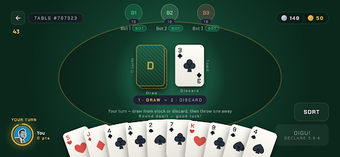
In this game you start with ten cards and your aim is to convert a messy hand into two sets of three and one set of four, then declare "Digu." The core loop is draw, arrange, discard; rounds end when a player calls Digu and scoring uses opponents' remaining cards. The rules emphasize pattern recognition and patient decision-making rather than fast reflexes.
Does it support multiplayer and private social tables?
In this game you can join real-time matches for two to four players via quick match or create a private table and invite friends with a code. Multiplayer uses server-side shuffling and dealing for validated fairness, and turn-based play sends "nudge" notifications to active players so matches progress without constant polling.
What does the mobile presentation and offline option look like?
In this game the interface is deliberately minimalist and designed for mobile screens, keeping cards and discard information visible. The app includes an offline practice mode where you play against AI opponents to rehearse meld patterns. Visuals and audio remain unobtrusive, keeping focus on hand management rather than flashy effects; the layout targets clarity on Android devices.
Is the learning curve and progression approachable?
In this game newcomers learn by arranging melds within each ten-card hand; there is no mention of complex skill trees or long unlock chains. Practice against AI gives a low-pressure environment to learn meld patterns, while real matches reward accurate grouping and timely declarations. The design treats difficulty as a player skill test rather than a gating mechanic.
Who should play Digu and when it fits best
Digu suits players who enjoy deliberate, pattern-based card strategy and social, turn-based matches on mobile. It rewards careful hand management and benefits players who use practice mode to learn meld composition. However, it does not target those seeking fast-action card games. For fans of traditional card culture seeking a faithful mobile adaptation, Digu is worth trying.